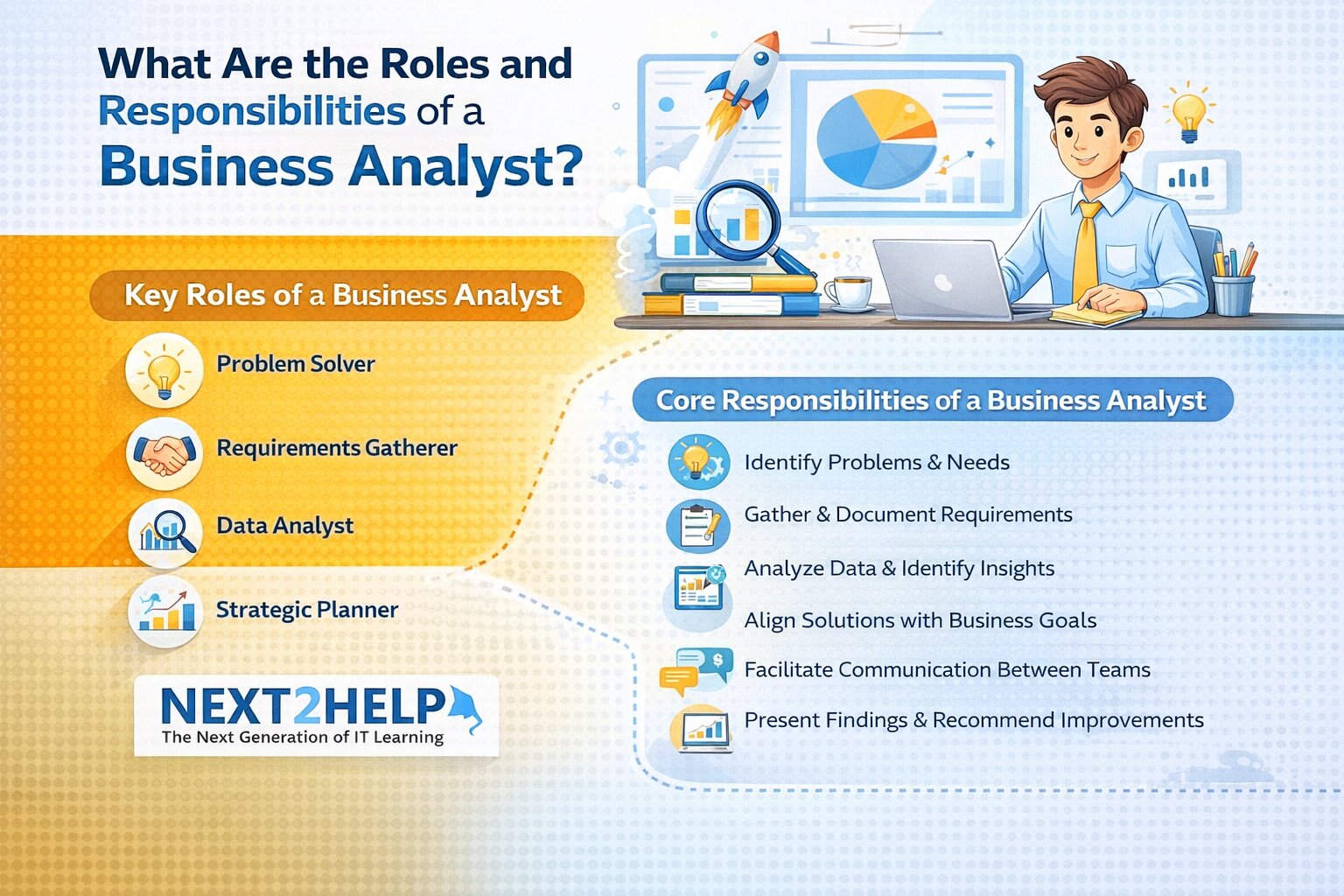
Business Analyst Roles and Responsibilities: What You Really Need to Know
| QUICK ANSWER | |
|
What Is a Business Analyst? In Simple Words
Think of a business analyst as a translator. On one side, you have business leaders with goals, problems, and ideas. On the other, you have developers and data teams who need precise instructions. The BA sits in the middle, understanding both worlds and making sure everyone is working toward the same outcome.
So when someone asks "what is the roles and responsibilities of business analyst," the simplest answer is: they find problems, analyse data, and help businesses make smarter decisions.
Business Analyst Job Roles and Responsibilities: The 6 Core Areas
Whether you work in a startup or a large corporation, business analyst job roles and responsibilities revolve around six key areas:
- Requirements Gathering: Requirements Gathering
Talking to stakeholders and teams to understand what the business actually needs, before any solution is built.
- Data Analysis: Data Analysis
Reviewing business data to spot trends, gaps, and opportunities that lead to better decisions.
- Documentation: Documentation
Writing clear requirement documents such as BRDs and FRDs that guide development and remove ambiguity.
- Stakeholder Communication: Stakeholder Communication
Acting as the go-between for business teams and technical teams throughout the project lifecycle.
- Process Improvement: Process Improvement
Identifying inefficiencies in existing workflows and recommending smarter, leaner processes.
- Solution Validation: Solution Validation
Testing and reviewing whether the final solution actually meets the original business requirements.
Business Analyst Roles Across Industries
One of the biggest strengths of this career is that it is not locked to one sector. Here is how business analyst roles and responsibilities vary by industry:
| Industry | Primary BA Focus | Common Deliverable |
| IT / Software | System requirement analysis, sprint planning support | User stories, FRDs |
| Finance & Banking | Risk modelling, regulatory compliance, cost analysis | Risk reports, financial models |
| Healthcare | Patient workflow optimisation, data compliance | Process maps, compliance docs |
| Retail & E-commerce | Customer behaviour analysis, inventory insights | Dashboard reports, A/B test findings |
| Manufacturing | Supply chain efficiency, cost reduction analysis | Lean process documentation |
Top Skills Every Business Analyst Needs
To truly excel in business analyst job roles and responsibilities, you need a combination of hard and soft skills:
- Critical and Analytical Thinking
- Data Tools such as Excel, Power BI, and SQL
- Business Process Modelling (BPMN)
- Stakeholder Management and Communication
- Requirement Elicitation Techniques
- Agile and Scrum Knowledge
- Clear Written and Verbal Communication
- Problem-Solving Under Pressure
Career Growth: Where Does a BA Go From Here?
Being a business analyst is a really interesting professional choice. You can start as a Junior BA and work your way up to Senior BA, then to Product Manager, Business Architect, Project Manager, or even Chief Strategy Officer. You may use the abilities you learn, such how to read data, manage stakeholders, and think about processes, in practically any field.
In 2026, the average salary for a business analyst in India will be between Rs. 5 and 8 LPA for a new hire and between Rs. 18 and 30 LPA for a senior hire. Global roles pay considerably more. As businesses rely more on data, the need is only going up.
Frequently Asked Questions
What is the difference between a Business Analyst and a Data Analyst?
A business Analyst looks at business procedures, requirements, and strategy, and then comes up with solutions that meet those needs. A Data Analyst's main job is to look over datasets and find statistical patterns. Data is a tool that business analysts utilize a lot, but data analysts make data their major product. The two professions are similar in many businesses, but the BA's main responsibility is to enhance the firm, not just evaluate numbers.
Do business analysts need to know coding or programming?
Not always. It's a big plus if you know SQL, Excel, or basic Python, but most business analyst jobs don't require you to know how to code. It's more important to know how systems function, how to read data, and how to tell engineers what you need in a technical way. A lot of BAs do well without ever writing code.
Is business analysis a good career in 2026?
Absolutely. Business analysis is one of the fastest-growing roles globally. With organisations increasingly relying on data to drive decisions, BAs are in high demand across IT, BFSI, healthcare, and retail. The role also offers strong upward mobility. Many BAs transition into product management, consulting, or leadership roles. Next2Help consistently sees it ranked among the top 10 most future-proof careers.
What certifications are best for a Business Analyst in India?
The most recognised certifications include CBAP (Certified Business Analysis Professional) by IIBA, PMI-PBA (Professional in Business Analysis) by PMI, and Agile BA certifications. For those starting out, a foundation-level course covering tools like Excel, Power BI, SQL, and business process modelling is a great starting point before pursuing advanced certifications.

Categories
Recent posts


Best Institute for a Digital Marketing ...
8 Jul 2024
Unlock Your Future with Next2Help Best ...
8 Jul 2024
is react native worth learning in 2026
17 Mar 2026